
Interview with Wilhelm Barthlott
Are you proud, Mr Barthlott?
Over 40 years ago, a young botanist made an extraordinary discovery in a greenhouse in Heidelberg: the leaves of the lotus plant clean themselves as water drops simply run off their surface, taking dirt particles with them.
Nowadays, the lotus effect is regarded as a milestone in biomimetics – the science that applies principles from the natural world to technical products. That is how, for example, Sto developed its Lotusan® facade paint. The young researcher in question, Wilhelm Barthlott, is now a retired professor He tells us all about the fascinating story behind his discovery:
Mr Barthlott, how did you discover the lotus effect?
It happened back in the 70s when I was a doctoral student and research assistant in Heidelberg. The first scanning electron microscopes had just been released. I found them fantastic because they meant that I could identify and systematise plant microstructures.
So I would go and collect leaves from the greenhouses. If you want to get decent images using an electron microscope, the leaves have to be clean. That means no mud, dust, or crusty irrigation water residue. And that’s when I noticed that I didn’t have to clean some of the leaves. Yet they had all been next to one another in the same greenhouse.
This was down to the self-cleaning effect of the lotus plant – a
complicated microtexture which causes water and dirt to simply roll off.

You won a lot of prizes for the discovery of the lotus effect. Why was it so well received?
Because it was completely unexpected. No other scientist before me had noticed the lotus effect. And that includes the biologists and the physicists, who just had a theory but no concrete surface or product.
The commercial potential of the lotus effect is huge given that what I discovered is so effective and technically relatively easy to apply to surfaces across a wide range of industrial fields. Not to mention that it is relevant in terms of environmental concerns because it can be used to replace a lot of toxic substances. Plus, it can be visually represented to great effect.
Why was it important that your research can be visually represented to great effect?
Because it meant that we got a lot of television coverage. Science journalist Ranga Yogeshwar played a huge role from the very beginning and, in fact, I am still in contact with him to this day. At the time, he had just finished studying Physics in Aachen and was already working for German broadcaster WDR. He just kept on reporting on the lotus effect: in the Lufthansa magazine, then on “Quarks & Co” and the programme called “Wissen vor Acht” just before the news, and on Galileo.
This made other broadcasters, such as RTL, Deutschlandfunk, ORF, BBC, and Arte, follow suit. And then within the space of three months, industrial players approached us, including the likes of BASF, Bayer-
Leverkusen, Degussa-Evonik, Erlus, and Procter & Gamble. But the most important one of all was a company called Ispo, which later became Sto.

The media attention was incredible. But before you got to that stage, you had to wait almost 20 years before being really accepted in the world of science and research...
No fewer than five big journals rejected our research articles. They were mostly physicists. They wrote things like: “The so-called lotus effect only exists in the fantasy of the author”. I got so angry about this. Many years later, one of those journals called me back because they were conducting research for a background article about this important discovery. And I simply replied: “Well it would have been better if you had just published the original article when I sent it to you!”
Why was it so difficult?
Because the lotus effect is so unusual. It is really surprising when you get a lotus plant all dirty and yet the dirt just rolls off. A rough surface that nothing can stick to is a contradiction.
When I first started back in 1975, nobody had thought about biomimetics or considered all the incredible things that nature can do. It’s a relatively new field of research. For a long time, I didn’t quite realise exactly what I had discovered. At first I thought that I had come across something new in the field of biology. But I had no idea that the physicists and material scientists were yet to find the lotus effect.
Once I had made my discovery, it took around 20 years for the
discussions to get going. For example at an institute for surface physics. By that point I was a Professor in Berlin. The answer was always the same. “We can’t comprehend that at all. It can’t be anything to do with physics. In fact, it just doesn’t work in line with physics. It must be somehow related to biology.” They just didn’t understand the unexpected principle.
And then we started to produce prototypes. Polymer surfaces with a complex water-repellent microarchitecture. And it worked.
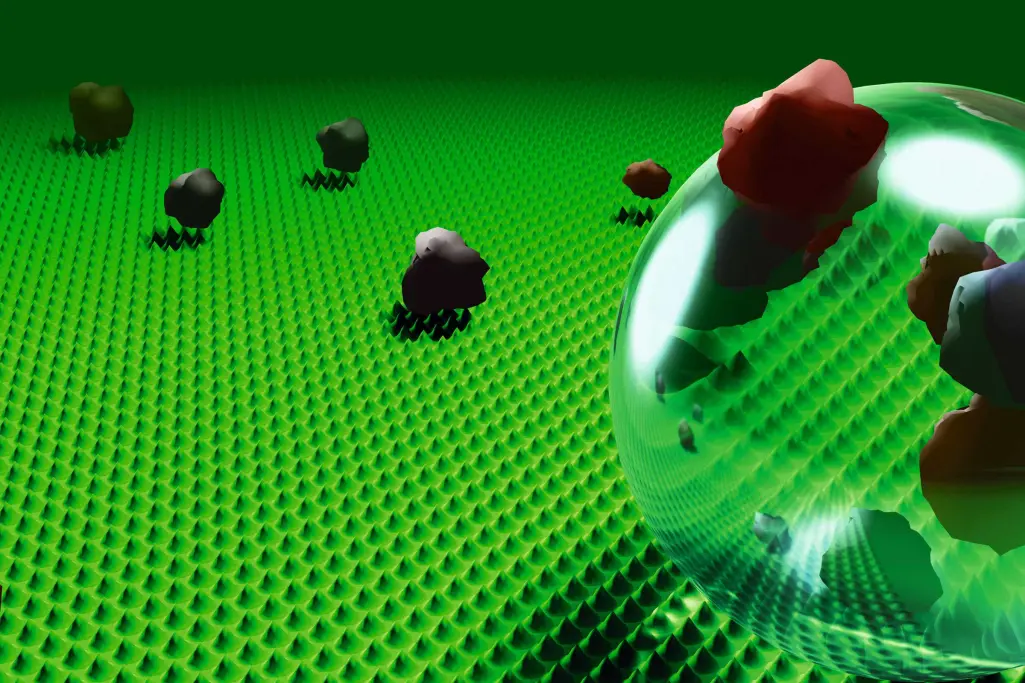
Sto has taken the principle of biomimetics further. StoColor Dryonic® facade paint is another example of drawing inspiration from the natural world. Are you proud?
Of course, I am still most proud of Lotusan®. But I am happy that companies have been working on this idea because they don’t all respond in the same way.
We have to remember that, unlike industrial companies, nature has had millions of years to evolve. A targeted approach needs to be pursued here. It would not have been possible to identify the property of the lotus effect when working on a specific research project because nobody knew about it before.
Sto realised very early on that biological constructions and principles held huge potential for technology, especially taking into account concerns about the environment. It really is a prime example amongst German companies.